Are you dead? Are you alive?
That's the whole question.
Leevalon reduces safety to that one bit — checked in, or not — and tracks nothing else. No location, no microphone, no one watching. On the day the answer stops arriving, it tells the one person you chose.


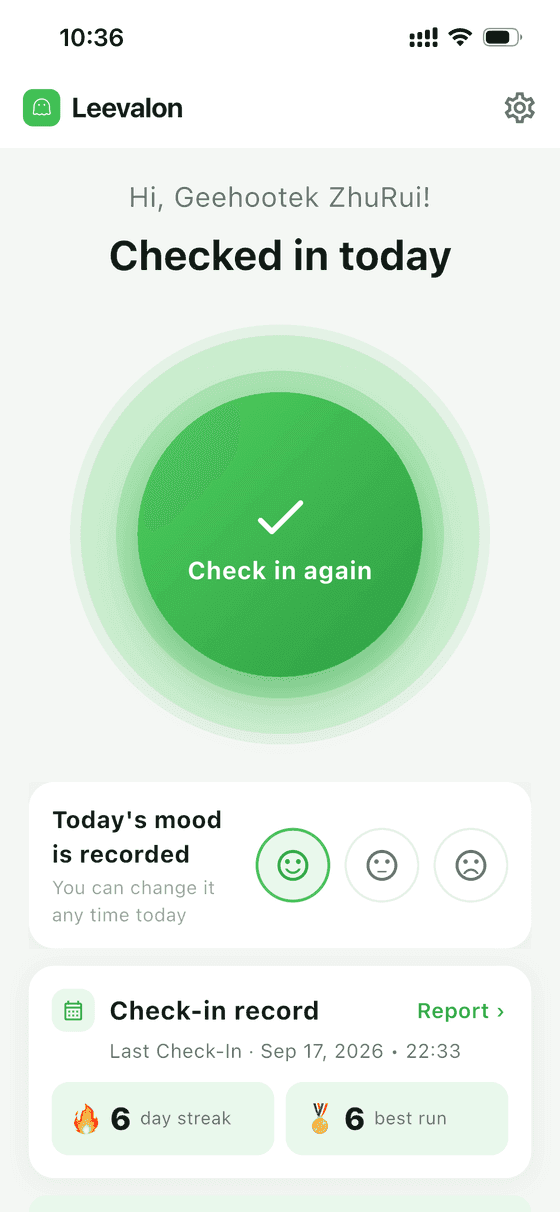
Nobody was told.
Design principle
The best safety net is one you never feel.
Most check-in apps — Demumu included — keep you safe by watching closely: logging, scoring, a report someone reviews. Leevalon does the opposite. It knows as little as possible, and does nothing at all until the one moment that matters.
You checked in. Nobody is told anything. The system spends almost all its time exactly here.
A day passes with no tap. Still nothing sent — a reminder, and the count ticking toward your limit.
The limit is reached. A single email, to a single contact. Then straight back to quiet.
The one message it can send
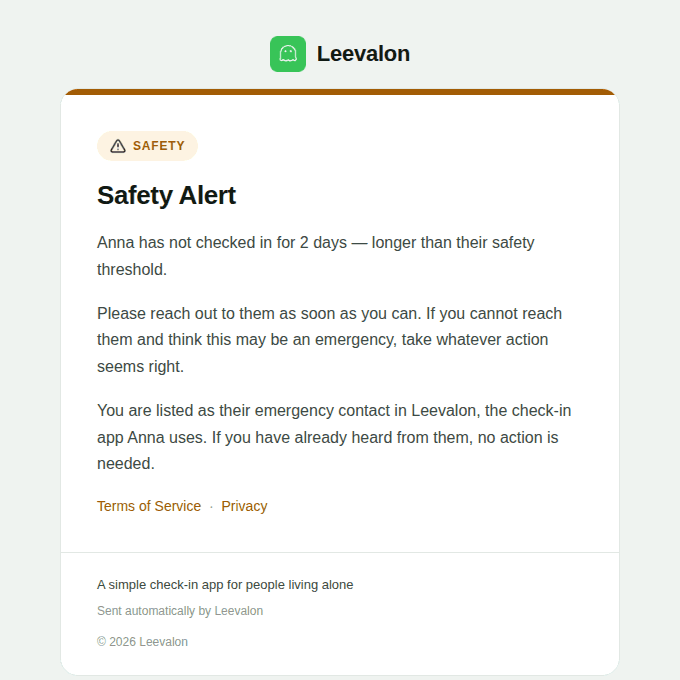
Just this — and only when it's true.
It reads like the person asked to be checked on, because that's exactly what happened, weeks earlier, when they set the threshold. One email. One recipient. Sent once.
Leevalon is not an emergency service. It sends an email — it cannot call an ambulance or the police. In an emergency, use your local emergency number.
Inside the app
Six small things, each doing one job well.
Every square is a day you were okay. Pauses show up honestly instead of looking like missed days.
Two days, three, whatever feels right — and the hour any alert would go out. Change it any time.
Traveling, or just want quiet? No reminders, no alerts. It switches back on by itself.
Streaks, trend over 8 weeks, an optional Monday email — to you, to your contact, or neither.
Three text sizes, applied to every screen at once — not just the body copy.
Configuration
Every number in the system is yours.
| Silence threshold | How many days without a check-in counts as worth a message. |
| Alert hour | What time of day the email would go out, if it goes out at all. |
| Data collected | One boolean per day: checked in, or not. No location, no microphone, no motion sensors. |
| Languages | English, 中文, 日本語, 한국어, Deutsch, Français, Español, Português, Italiano, हिन्दी, العربية. |
Stay safe. Stay quiet.
Living alone doesn't have to mean unaccounted for.